• About Us
  • Container Lifting Equipment
    • Fixed Spreaders
    • Ship to Shore Crane Spreaders
    • Mobile Harbour Crane Spreaders
    • Overheight Spreaders
    • Straddle Carrier Spreaders
    • Yard Crane Spreaders
    • Piggyback spreaders
    • Stinis Split-Headblock
    • Safety Equipment
    • chains & components
  • Service
  • Jobs
  • News
  • Contact

Stinis at TOC Europe 2026 in Hamburg
Connecting, Learning, Moving Forward

At the end of May, Stinis was present at TOC Europe in Hamburg,
one of the leading international events for the global port and terminal industry.
WhatsApp Image 2026-06-08 at 08.47.55

A Key Event for the Port Industry

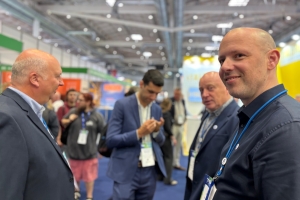
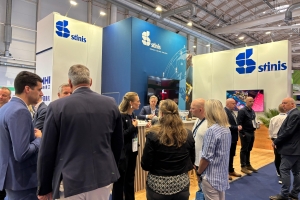
TOC Europe brings together industry professionals from around the world, including terminal operators, equipment manufacturers and technology providers. The event focuses on innovation, operational efficiency and the future of container logistics. For Stinis, it is a valuable opportunity to stay closely connected to market developments and to better understand the challenges and needs our customers face on a daily basis.
WhatsApp Image 2026-06-08 at 08.49.25

Committed to Reliable Partnerships

Throughout all meetings and discussions, one message remained central: Stinis stands by its customers. Not only when operations run smoothly, but especially when challenges arise. This commitment to partnership and reliability continues to be the foundation of everything we do.
WhatsApp Image 2026-06-08 at 08.49.44

Strengthening
Connections

During the event, we met with long-standing customers as well as new contacts. These conversations give us direct insight into how our equipment performs in real-life operations and where improvements or innovations can add value. At the same time, TOC is the ideal platform to introduce Stinis to new partners and expand our international network.

WhatsApp Image 2026-06-08 at 08.50.48

Social Tables
Event

A key highlight of the week was our Social Tables event on Tuesday evening. Together with around 70 customers, we created an informal setting where experiences, ideas and perspectives were openly shared. Events like these strengthen relationships beyond the exhibition floor and provide valuable input for future developments.

Long-Twin Operation at Montecon

Red line

09 November 2023, Krimpen aan de Lek

The Stinis ‘Long-Twin’ is the original concept for a separating twin-20 spreader where the distance between two 20ft boxes can be adjusted by up to 1.6m.

“The Long-Twin concept was developed and patented by Kees Stinis in the mid-1990s,” said Lisette Stinis, who now heads the company. “Today, it is the standard for ship-to-shore gantry crane operations and a popular option for straddle carrier spreaders. It is nice to see that the concept is still evolving.”

The impetus to develop the Long-Twin MHC version came from Montecon SA in Montevideo, Uruguay, which uses three high-capacity Liebherr LHM 800 MHCs and enquired about the possibility of incorporating the Long-Twin separating mechanism into an MHC spreader. Stinis took up the challenge and developed a new product for MHCs.

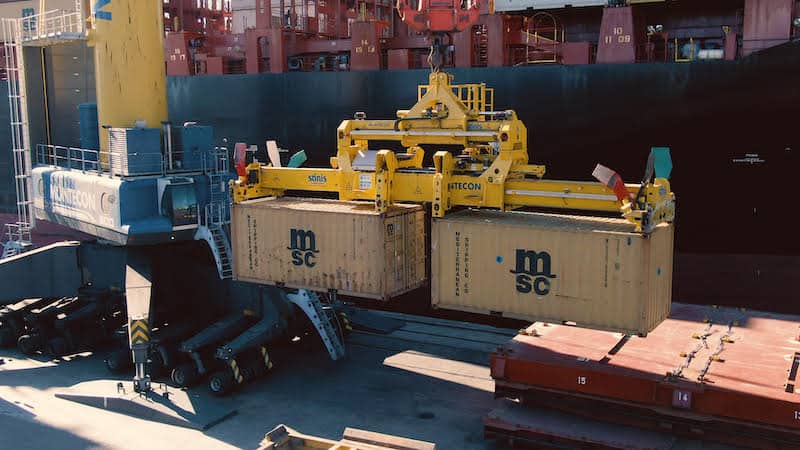
The Long-Twin MHC spreader combines Stinis’s existing MHC spreader design with the well-proven twin-20 inner twistlock assemblies and separating mechanism from the STS Long-Twin design.

Staying on the level

Improved Flexibility for Twin-20 Container Handling

One of the biggest challenges in applying the Long-Twin concept to an MHC spreader is the centre of gravity (CoG) adjustment to keep the spreader level. Stinis MHC spreaders feature a CoG design where the spreader frame moves inside the mounting frame, rather than a tower that slides atop the spreader.

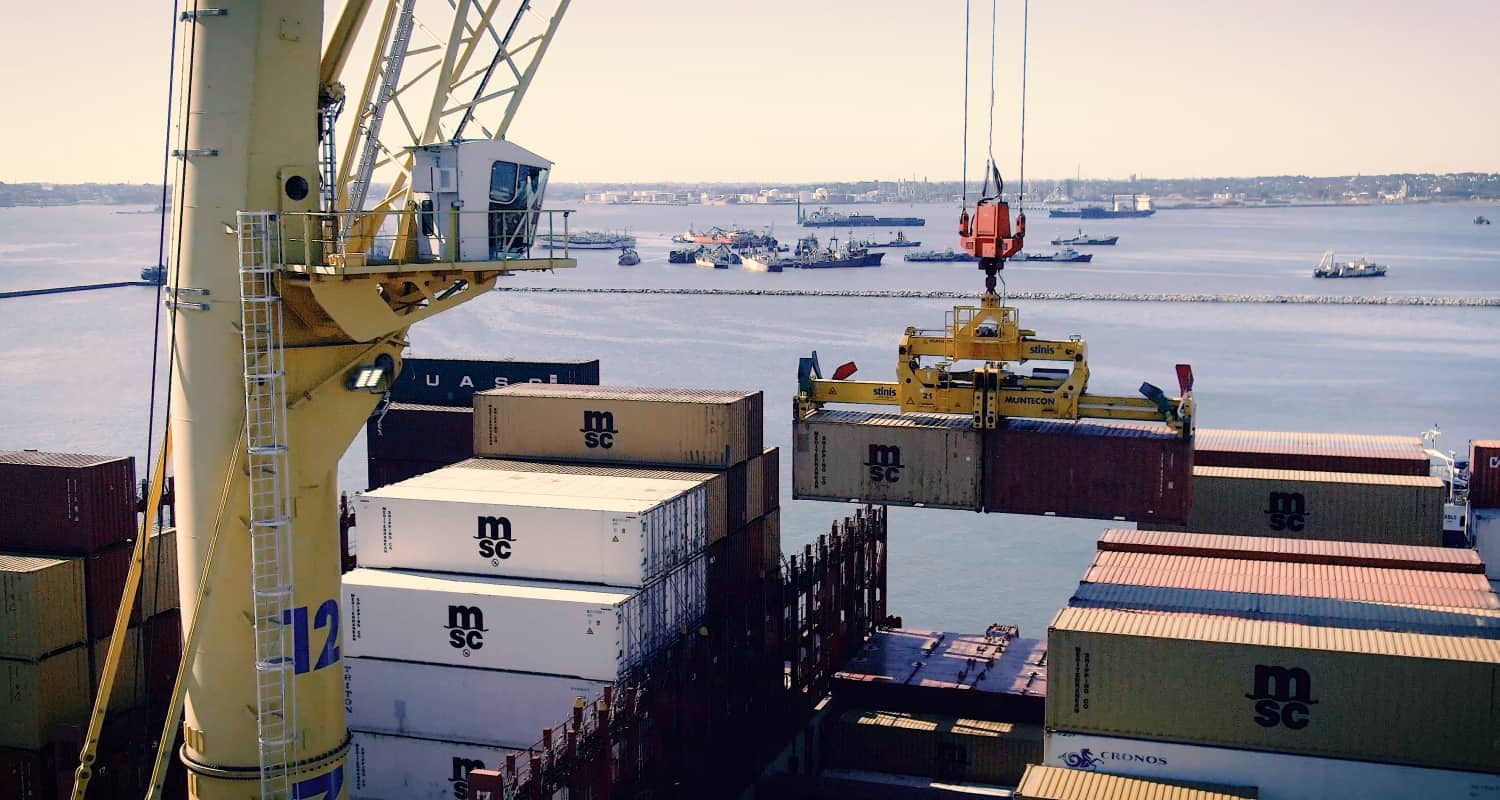
For the Long-Twin MHC spreader, Stinis has developed a two-piece design where a new CoG mechanism is contained in the upper section that is connected to the MHC load hook. This part resembles a headblock and is connected with twistlocks to the spreader unit itself (as pictured).

The CoG system includes an inclinometer that provides a signal to a PLC to control a skew cylinder that moves the upper beam that supports the spreader left and right to keep the spreader itself level. The maximum allowable weight difference between two 20ft containers is 15t. Stinis has tested the system to a higher weight differential, but 15t has been selected as the operating parameter. If the weight difference exceeds this level, the control system indicates that the containers cannot be handled together.

For integration with the crane’s control system, Stinis provides a 36-pin plug for control signals. As Montecon’s Liebherr LHM 800 was delivered in 2019, not all the spreader functions are integrated into the crane controls. Stinis supplied a separate remote control unit that operates certain features, including the twin-20 detection system bypass.

Lifting Capacity

As MHCs are jib cranes with a load capacity that decreases as outreach increases, the SWL under the spreader follows the load curve set by the crane OEM Importantly, the load curve for twinlift spreader operations has to take into account the spreader weight. For Montecon, the complete Long-Twin MHC spreader system weighs 18.3t. However this includes Stinis’s Shock Absorbing System, which weighs 800 kg. The spreader is also built to handle a 50t load in the 45ft position, which requires extra plate thickness in some areas and it is equipped with six flippers. Stinis sales manager Huib Schot said that a lighter version designed to handle a maximum of 41t in the 40ft position would weigh less than 17t.

Montecon’s LHM 800 is Liebherr’s largest MHC, so the spreader weight is not an operational constraint. As Montecon is located in the vicinity of residential areas, Stinis proposed its Active Shock Absorbing System which reduces impacts by 50% and noise by 3 dB during landing and hoisting, which is important in 24/7 operations, but, as noted above, adds weight.

Stinis Mobile Haarbour Crane Spreader Long-Twin - Montecon, Uruguay

For the LHM 800, the Stinis Long-Twin is the crane’s main spreader, and Montecon intends it to stay on the crane for all container operations. For other terminals with smaller MHCs, the weight of the spreader could result in some operational constraints. Schot said Stinis is talking to some interested customers about how they can manage the extra weight and benefit from the increased productivity of the Long-Twin design with smaller MHCs.

This has to be considered on a case-by-case basis, but Schot said it is possible that some terminals might opt to use the Long-Twin only for handling empties or lightly loaded containers, in the same way as terminals with lower capacity STS gantry cranes use twinlift spreaders. This is particularly the case for terminals that handle large numbers of empty reefer containers, sometimes a whole vessel, brought in to load seasonal cargo.

With regard to the height of the Long-Twin, it is interesting to note that the spreader and headblock system are only 100mm higher than Stinis’s standard MHC spreader and CoG adjustment. To facilitate safe spreader changes without requiring a cherry picker to make the connection at the crane hook, Stinis has incorporated access stairs and a platform.

The Long-Twin MHC spreader comes on to the market at a time when MHCs are getting progressively larger, and are, therefore, better able to have the capacity to perform twinlift operations. It will be interesting to see how crane demand responds to the availability of a separating twinlift spreader. In STS gantry cranes, the Long-Twin increased the potential for twinlift operations considerably and helped make a 65t capacity hoist the virtual standard for new STS cranes.

The view from Montecon

Diego Suaìrez, operations manger at Montecon, explained that the Long-Twin spreader has significantly increased the opportunity for twin-20 container handling at the terminal in Montevideo.

Previously, Montecon had other twin-20 spreaders for its cranes, but they did not have enough capacity for the loaded containers it handles. The spreaders also had limited utility because of Montecon’s process for inspecting container seals at the point of discharge.

Montecon inspects container seals and records their numbers when the boxes are discharged onto the quay. It uses trailer sets that are long enough for a physical inspection in the space between two 20ft boxes with the doors facing each other. This inspection was not possible with a non-separating twin- 320 spreader. This factor, together with the loading capacity limitation, meant Montecon only used the twinlift spreaders to handle empty containers, so around 7% of its 20ft container throughput could be handled in twinlift mode.

With the Stinis Long-Twin spreader, the spreader capacity and inspection issues are resolved, and Montecon expects to make much greater use of twinlift operations. “We estimate we can increase productivity by about 10% in terms of moves per hour per crane using these spreaders,” said Suaìrez.

While there is potential to also use a Long-Twin on some of the other cranes, the 20ft to 40ft container ratio at the terminal means there would not be much opportunity to use more than two cranes at a time in twinlift mode.

With regard to implementing the new spreader, Monte- con’s instructors undertook a short training course and were then able to instruct the rest of the operators. Suaìrez said that the operators had to adjust to the greater weight of the new spreader and its different response to control commands, “but they were able to pick it up fairly easily”. The high torque of the Stinis flipper system has also proved to be a good benefit to which the operators have been able to adjust quickly.

Long-Twin Operation at Montecon

Red line

09 November 2023, Krimpen aan de Lek

The Stinis ‘Long-Twin’ is the original concept for a separating twin-20 spreader where the distance between two 20ft boxes can be adjusted by up to 1.6m.

“The Long-Twin concept was developed and patented by Kees Stinis in the mid-1990s,” said Lisette Stinis, who now heads the company. “Today, it is the standard for ship-to-shore gantry crane operations and a popular option for straddle carrier spreaders. It is nice to see that the concept is still evolving.”

The impetus to develop the Long-Twin MHC version came from Montecon SA in Montevideo, Uruguay, which uses three high-capacity Liebherr LHM 800 MHCs and enquired about the possibility of incorporating the Long-Twin separating mechanism into an MHC spreader. Stinis took up the challenge and developed a new product for MHCs.

The Long-Twin MHC spreader combines Stinis’s existing MHC spreader design with the well-proven twin-20 inner twistlock assemblies and separating mechanism from the STS Long-Twin design.

Staying on the level

One of the biggest challenges in applying the Long-Twin concept to an MHC spreader is the centre of gravity (CoG) adjustment to keep the spreader level. Stinis MHC spreaders feature a CoG design where the spreader frame moves inside the mounting frame, rather than a tower that slides atop the spreader.

For the Long-Twin MHC spreader, Stinis has developed a two-piece design where a new CoG mechanism is contained in the upper section that is connected to the MHC load hook. This part resembles a headblock and is connected with twistlocks to the spreader unit itself (as pictured).

The CoG system includes an inclinometer that provides a signal to a PLC to control a skew cylinder that moves the upper beam that supports the spreader left and right to keep the spreader itself level. The maximum allowable weight difference between two 20ft containers is 15t. Stinis has tested the system to a higher weight differential, but 15t has been selected as the operating parameter. If the weight difference exceeds this level, the control system indicates that the containers cannot be handled together.

For integration with the crane’s control system, Stinis provides a 36-pin plug for control signals. As Montecon’s Liebherr LHM 800 was delivered in 2019, not all the spreader functions are integrated into the crane controls. Stinis supplied a separate remote control unit that operates certain features, including the twin-20 detection system bypass.

Improved Flexibility for Twin-20 Container Handling

Lifting Capacity

As MHCs are jib cranes with a load capacity that decreases as outreach increases, the SWL under the spreader follows the load curve set by the crane OEM Importantly, the load curve for twinlift spreader operations has to take into account the spreader weight. For Montecon, the complete Long-Twin MHC spreader system weighs 18.3t. However this includes Stinis’s Shock Absorbing System, which weighs 800 kg. The spreader is also built to handle a 50t load in the 45ft position, which requires extra plate thickness in some areas and it is equipped with six flippers. Stinis sales manager Huib Schot said that a lighter version designed to handle a maximum of 41t in the 40ft position would weigh less than 17t.

Montecon’s LHM 800 is Liebherr’s largest MHC, so the spreader weight is not an operational constraint. As Montecon is located in the vicinity of residential areas, Stinis proposed its Active Shock Absorbing System which reduces impacts by 50% and noise by 3 dB during landing and hoisting, which is important in 24/7 operations, but, as noted above, adds weight.

For the LHM 800, the Stinis Long-Twin is the crane’s main spreader, and Montecon intends it to stay on the crane for all container operations. For other terminals with smaller MHCs, the weight of the spreader could result in some operational constraints. Schot said Stinis is talking to some interested customers about how they can manage the extra weight and benefit from the increased productivity of the Long-Twin design with smaller MHCs.

This has to be considered on a case-by-case basis, but Schot said it is possible that some terminals might opt to use the Long-Twin only for handling empties or lightly loaded containers, in the same way as terminals with lower capacity STS gantry cranes use twinlift spreaders. This is particularly the case for terminals that handle large numbers of empty reefer containers, sometimes a whole vessel, brought in to load seasonal cargo.

With regard to the height of the Long-Twin, it is interesting to note that the spreader and headblock system are only 100mm higher than Stinis’s standard MHC spreader and CoG adjustment. To facilitate safe spreader changes without requiring a cherry picker to make the connection at the crane hook, Stinis has incorporated access stairs and a platform.

The Long-Twin MHC spreader comes on to the market at a time when MHCs are getting progressively larger, and are, therefore, better able to have the capacity to perform twinlift operations. It will be interesting to see how crane demand responds to the availability of a separating twinlift spreader. In STS gantry cranes, the Long-Twin increased the potential for twinlift operations considerably and helped make a 65t capacity hoist the virtual standard for new STS cranes.

Stinis Mobile Haarbour Crane Spreader Long-Twin - Montecon, Uruguay

The view from Montecon

Diego Suaìrez, operations manger at Montecon, explained that the Long-Twin spreader has significantly increased the opportunity for twin-20 container handling at the terminal in Montevideo.

Previously, Montecon had other twin-20 spreaders for its cranes, but they did not have enough capacity for the loaded containers it handles. The spreaders also had limited utility because of Montecon’s process for inspecting container seals at the point of discharge.

Montecon inspects container seals and records their numbers when the boxes are discharged onto the quay. It uses trailer sets that are long enough for a physical inspection in the space between two 20ft boxes with the doors facing each other. This inspection was not possible with a non-separating twin- 320 spreader. This factor, together with the loading capacity limitation, meant Montecon only used the twinlift spreaders to handle empty containers, so around 7% of its 20ft container throughput could be handled in twinlift mode.

With the Stinis Long-Twin spreader, the spreader capacity and inspection issues are resolved, and Montecon expects to make much greater use of twinlift operations. “We estimate we can increase productivity by about 10% in terms of moves per hour per crane using these spreaders,” said Suaìrez.

While there is potential to also use a Long-Twin on some of the other cranes, the 20ft to 40ft container ratio at the terminal means there would not be much opportunity to use more than two cranes at a time in twinlift mode.

With regard to implementing the new spreader, Monte- con’s instructors undertook a short training course and were then able to instruct the rest of the operators. Suaìrez said that the operators had to adjust to the greater weight of the new spreader and its different response to control commands, “but they were able to pick it up fairly easily”. The high torque of the Stinis flipper system has also proved to be a good benefit to which the operators have been able to adjust quickly.

Meet Stinis Asia Pacific

Red line

20 february 2024, Singapore

Our team in Asia at plays a vital role in serving operator and shipping line clients across Asia, Africa, Australia, and New Zealand. Their unwavering dedication and expertise have solidified Stinis’s reputation as a trusted partner in the industry.

Beyond our sales team in Singapore, Stinis has a container spreader production facility in Malaysia. This facility operates in harmony with Stinis’s manufacturing unit in The Netherlands, adhering to the same high engineering, production, and quality standards. Both facilities are proudly ISO 9001-certified, ensuring that every product meets rigorous quality benchmarks.

Since 2022, Stinis Malaysia has achieved ISO 14001 and ISO 45001 certifications, underscoring the company’s commitment to environmental sustainability and occupational health and safety. The presence of service engineers at the Malaysian facility, coupled with a global network of service agents, enables Stinis to provide unparalleled remote and on-site support to customers worldwide.

Stinis’s collaborative approach between its facilities and dedication to excellence sets it apart in the industry. With a focus on quality, innovation, and customer satisfaction, Stinis continues to strengthen its position as a leader in the container spreader manufacturing sector.

Meet Stinis Asia Pacific

Red line

20 february 2024, Singapore

Our team in Asia at plays a vital role in serving operator and shipping line clients across Asia, Africa, Australia, and New Zealand. Their unwavering dedication and expertise have solidified Stinis’s reputation as a trusted partner in the industry.

Beyond our sales team in Singapore, Stinis has a container spreader production facility in Malaysia. This facility operates in harmony with Stinis’s manufacturing unit in The Netherlands, adhering to the same high engineering, production, and quality standards. Both facilities are proudly ISO 9001-certified, ensuring that every product meets rigorous quality benchmarks.

Since 2022, Stinis Malaysia has achieved ISO 14001 and ISO 45001 certifications, underscoring the company’s commitment to environmental sustainability and occupational health and safety. The presence of service engineers at the Malaysian facility, coupled with a global network of service agents, enables Stinis to provide unparalleled remote and on-site support to customers worldwide.

Stinis’s collaborative approach between its facilities and dedication to excellence sets it apart in the industry. With a focus on quality, innovation, and customer satisfaction, Stinis continues to strengthen its position as a leader in the container spreader manufacturing sector.

TIC 4.0 MEMBERSHIP

Red line
TIC-4.0-news-09-2022

September 16th 2022, Krimpen aan de Lek

We are excited and honored to take part in Terminal industry committee 4.0! The purpose of TIC4.0 is to define, promote and adopt a common language to enable seamless exchange of data between equipment and information systems in the maritime industry. A common language will make it less costly and complex to measure process and equipment performance, paving the way for continuous improvement. In the spirit of improving cargo handling efficiency and decarbonizing maritime transport, a very welcome initiative!

We thank Boris Wenzel, Francisco Blanquer Jaraiz, Norbert Klettner, José Andrés Giménez Maldonado, Luisa Kemph and Frank Kho for the warm welcome in the association. We also thank Port Equipment Manufacturers Association and FEPORT for endorsing this initiative, and we look forward contribute with our team in the Spreader Task Force.

About TIC4.0

TIC4.0 is an open association with almost 40 leading terminal operators and global suppliers of equipment, technology and solutions who decided to join forces to develop common standards to accelerate innovation and 4.0 technologies adoption. Maybe your company should become a member of TIC4.0?  Visit www.TIC40.org for more information or contact secretary.general@tic40.org

TIC 4.0 MEMBERSHIP

Red line
TIC-4.0-news-09-2022

September 16th 2022, Krimpen aan de Lek

We are excited and honored to take part in Terminal industry committee 4.0! The purpose of TIC4.0 is to define, promote and adopt a common language to enable seamless exchange of data between equipment and information systems in the maritime industry. A common language will make it less costly and complex to measure process and equipment performance, paving the way for continuous improvement. In the spirit of improving cargo handling efficiency and decarbonizing maritime transport, a very welcome initiative!

We thank Boris Wenzel, Francisco Blanquer Jaraiz, Norbert Klettner, José Andrés Giménez Maldonado, Luisa Kemph and Frank Kho for the warm welcome in the association. We also thank Port Equipment Manufacturers Association and FEPORT for endorsing this initiative, and we look forward contribute with our team in the Spreader Task Force.

About TIC4.0

TIC4.0 is an open association with almost 40 leading terminal operators and global suppliers of equipment, technology and solutions who decided to join forces to develop common standards to accelerate innovation and 4.0 technologies adoption. Maybe your company should become a member of TIC4.0?  Visit www.TIC40.org for more information or contact secretary.general@tic40.org

FIND STINIS AT THE TRANS MIDDLE EAST 2023

Red line
Transmiddle-East-01-2023

January 23th 2023, Krimpen aan de Lek

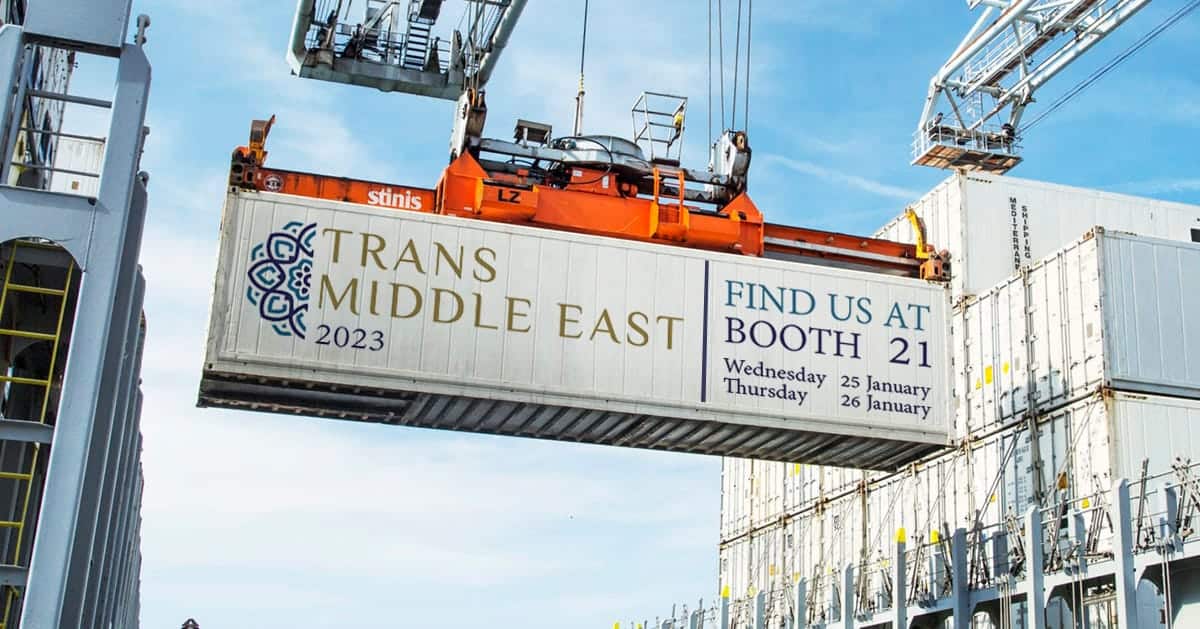
Are you curious about our latest developments and do you want to meet our team? We will be attending the Trans Middle East this year on the 25th and 26th of January. Trans Middle East continues to be the biggest and longest established annual Container Ports and Terminal Operations Exhibition and Conference in the Middle East. The 19th Trans Middle East 2023 Exhibition and Conference takes place in the United Arab Emirates from Wednesday 25 to Thursday 26 January 2023 at the luxurious five star Movenpick Grand Al Bustan Dubai.

A two days international Conference Programme will feature 30 world-class conference speakers addressing topical issues and challenges on global transportation and logistics attended by a gathering of 300 senior executive harbour masters, harbour engineers, port engineers, maintenance supervisors and procurement decision makers together with the region’s leading shippers, cargo owners, importers / exporters, shipping lines, freight forwarders, logistics companies, ports, terminal operating companies, railway operators, port equipment and services suppliers from countries throughout the GCC region.

TRANS MIDDLE EAST 2023

Red line
Transmiddle-East-01-2023

January 23th 2023, Krimpen aan de Lek

Are you curious about our latest developments and do you want to meet our team? We will be attending the Trans Middle East this year on the 25th and 26th of January. Trans Middle East continues to be the biggest and longest established annual Container Ports and Terminal Operations Exhibition and Conference in the Middle East. The 19th Trans Middle East 2023 Exhibition and Conference takes place in the United Arab Emirates from Wednesday 25 to Thursday 26 January 2023 at the luxurious five star Movenpick Grand Al Bustan Dubai.

A two days international Conference Programme will feature 30 world-class conference speakers addressing topical issues and challenges on global transportation and logistics attended by a gathering of 300 senior executive harbour masters, harbour engineers, port engineers, maintenance supervisors and procurement decision makers together with the region’s leading shippers, cargo owners, importers / exporters, shipping lines, freight forwarders, logistics companies, ports, terminal operating companies, railway operators, port equipment and services suppliers from countries throughout the GCC region.

Are you curious about our latest developments and want to meet our team. We will be attending the Trans Middle East this year on the 25th and 26th of January.

Trans Middle East continues to be the biggest and longest established annual Container Ports and Terminal Operations Exhibition and Conference in the Middle East.

The 19th Trans Middle East 2023 Exhibition and Conference takes place in the United Arab Emirates from Wednesday 25 to Thursday 26 January 2023 at the luxurious five star Movenpick Grand Al Bustan Dubai.

A two days international Conference Programme will feature 30 world-class conference speakers addressing topical issues and challenges on global transportation and logistics attended by a gathering of 300 senior executive harbour masters, harbour engineers, port engineers, maintenance supervisors and procurement decision makers together with the region’s leading shippers, cargo owners, importers / exporters, shipping lines, freight forwarders, logistics companies, ports, terminal operating companies, railway operators, port equipment and services suppliers from countries throughout the GCC region.

Pages

Container Lifting Equipment
About us
Services
News
Jobs

Contact

Stinis Holland
Stinis Singapore
Stinis Malaysia

Social Media

facebook stinisblack pixel instagram stinisblack pixellinkedin stinis

Back to top ^

Last posts

  • TOC Europe 2026
  • Sales Manager
  • Mechanical Project Engineer

Stinis © 2021–2026 - Disclaimer - Cookies - Privacy Statement